
Power cables, power cords, and electric wires are often lumped together in the market. However, as a professional power cable manufacturer, we must clarify that the differences between them are significant. Choosing the wrong type can lead to a waste of time and money, while using the incorrect product poses serious safety risks.
Understanding Wires, Cables, and Cords
Wire
A single, slender strand of metal wire characterized by excellent flexibility, widely used for conductivity, connection, and securing applications.
In the field of electrical wiring, it is commonly used for conduit installation within buildings and internal connections in distribution boxes, with typical products including THHN, BV, and BVR wires. In electromagnetic equipment, it serves as the core winding for motors, transformers, and inductors, such as enamelled copper wire. In the renewable energy sector, it is responsible for the series connection between solar panel arrays, as seen in photovoltaic (PV) wires. Meanwhile, in the mechanical industry, it is utilized for bundling, fencing, or spring manufacturing, such as galvanized iron wire.


Cord
A thin, flexible cord or wire composed of fibers or fine metallic strands, used for binding, connecting, or power supply. Its defining characteristics are ease of movement and superior bendability.
The most common application is the connection lead between household appliances and power outlets, known as a power cord or extension cord. In industrial sectors, it takes the form of highly abrasion-resistant rubber flexible cables used to connect mobile construction machinery or handheld tools. In non-electrical contexts, it refers to various high-performance fiber ropes, such as climbing ropes or decorative drawstrings.


Cable
A cable is composed of multiple insulated wires bundled together, typically encased in a unified protective sheath, and primarily used for long-distance, fixed-location energy or signal transmission.

It encompasses not only power cables within urban grids and industrial power systems—such as medium and low voltage (MV/LV) cables and Aerial Bundled Cables (ABC)—but also data transmission lines in internet backbones, such as fiber optic cables and Ethernet cables. Furthermore, it plays a critical role in mechanical load-bearing applications, such as the steel wire cables used in elevators or stayed bridges.
Therefore, in terms of electrical applications, the most intuitive way to distinguish them based on literal definitions is as follows:
- Electric Wire: You can see a single metallic strand with a very simple structure.
- Power Cable: These are typically thicker and often used for fixed installation in industrial, infrastructure, or residential feeder applications — not usually found as flexible appliance cords. Their internal structure is complex, consisting of multiple specialized layers.
- Power Cord: The type of cord that can be held in your hand and easily bent or moved.
Distinguishing Between Power Cables, Power Cords, and Electric Wires
Power cables, power cords, and electric wires feature distinct structural designs.
Electric Wire
A single conductive path (with or without an insulation layer). Its typical structure consists of a solid or stranded copper/aluminum conductor. It serves as the “basic unit” of electrical systems and is usually concealed within walls, conduits, or inside machinery.
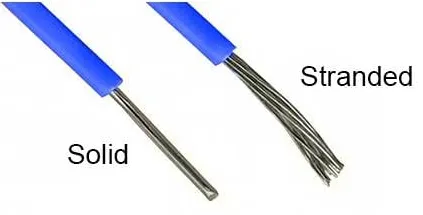
Solid Wire: Consists of a single, thick copper strand. Commonly used for in-wall conduit wiring in residential buildings (e.g., BV wire). Its advantages include stable conductivity and ease of shaping within junction boxes.
Stranded Wire: Composed of multiple thick copper strands twisted together (e.g., BVR wire). It is more flexible than solid wire, making it easier to pull through conduits and ideal for internal wiring in distribution boxes.
Enamelled Wire (Magnet Wire): A single copper wire coated with an extremely thin layer of insulating film. It is primarily used for windings in motors and transformers—a classic “internal machine” application.

Bare Copper Wire: Frequently used for lightning protection and grounding systems.

Power Cord
Multi-conductor + High-flexibility structure. The core attribute is “Portability.” It serves as a bridge connecting “fixed power outlets” to “mobile electrical appliances.” It is frequently plugged/unplugged, dragged, and coiled.

Typical structure: [Fine multi-strand conductors] + [Individual insulation] + [Overall outer jacket]. It usually appears as a finished assembly, equipped with plugs or connectors.
- Household Appliance Power Cord (SPT / H03VV): Flat or round flexible cords used for lamps, televisions, and chargers.
- Heavy-Duty Rubber Cord (e.g., SOOW / H07RN-F): Featuring a polychloroprene (neoprene) jacket, it is oil-resistant and UV-resistant, designed for construction sites, handheld power tools, or mobile mining equipment.
- Extension Cord: A finished assembly specifically fitted with both a plug and a socket.
Power Cable
Multi-conductor + Protective structure. Industrial-grade cables (heavy-duty cables) often feature complex, multi-layered designs. The core attribute of cables used in industrial applications is “Fixed Installation.” Their complex construction is engineered to withstand harsh environments (e.g., moisture resistance, compression resistance, and electromagnetic interference (EMI) shielding). Typically installed on cable trays, underground, or on supports, they remain in place for decades once commissioned.

However, not all power cables are complex. In residential applications, light-duty power cables—professionally known as non-metallic sheathed cables (NM cables)—are commonly used. For example, in-wall or conduit wiring often consists of three color-coded independent wires (typically Red for Live, Blue for Neutral, and Green/Yellow for Earth) encased in an outer jacket. Their jackets are quite thin, serving primarily for insulation and basic physical separation. Each of these three internal components is called an “electric wire,” but together they form a “cable.” Consequently, in daily life, people often refer to this type of cable as “building wire” (or building cable).

| Electric Wire | Power Cord | Power Cable | |
| Number of Conductors | Primarily Single-core | Multi-core | Multi-core |
| Conductor Structure | Solid / Rigid Stranded | Fine multi-strand (High-flexibility), extra-fine copper wires for bending resistance | Coarse stranded (Typically large cross-sections) |
| Insulation | With or Without | Mandatory | Mandatory |
| Sheath / Jacket | Typically 0 – 1 layer | Typically 2 layers (Must have overall jacket) | 2 or more layers (Including inner & outer sheaths) |
| Structural Complexity | Low | Medium | High |
| Shielding | None | Rarely | Common |
| Armoring | None | None | Optional (Available) |
| Mechanical Protection | Low | Medium | High |
| Flexibility | Low / Medium | High | Low / Medium |
| Movement Status | Static (Protected in conduits/boxes) | Frequent moving / Plugging / Coiling | Fixed installation (Underground or Overhead) |
| Protection Focus | Electrical Insulation | Fatigue & Abrasion Resistance | Mechanical Protection (Compression & Chemical Resistance) |
| Measurement Unit | Gauge (AWG) of single strand | Amperage (Amps) + Flexibility | Core count + Cross-section ($mm^2$) + Voltage Class |
Electric Wire, Power Cord, and Power Cable: Can They Be Used Interchangeably?
In short, no. Cable selection follows the principle of “Application-Specific Use.” Substituting high-specification, complex-environment products with lower-spec, simpler structures directly compromises the safety redundancy of the electrical system.Conversely, while substituting basic products with higher-spec, more complex ones is generally safer, it creates a series of practical, cost, and spatial challenges.
To better understand these limitations, let’s examine common substitution scenarios one by one.
Can electric wire be substituted with a power cord?
This is highly discouraged. A power cord’s outer jacket is designed for abrasion resistance and flexibility, not for long-term resistance to chemical corrosion within walls or heat accumulation in enclosed spaces. Moreover, since flexible cords consist of extra-fine copper wires with a large total surface area, they are more prone to oxidation under high currents. Their poor heat dissipation in confined environments poses a significant fire hazard.
Lack of Protection: Electric wires lack the protection of an outer jacket or armor. In direct-burial or industrial environments, if the insulation is punctured by stones and moisture seeps in, the entire circuit will suffer an instantaneous ground fault or short circuit, potentially energizing the surrounding ground.
Can electric wire be substituted with a power cable?
Although theoretically possible, it is practically unfeasible.
Power cables are rigid—especially armored versions—making them heavy, bulky, and possessing a large diameter. They cannot navigate right-angle bends, making them impossible to install as a replacement for electric wire or to fit into standard junction boxes.
Compatibility Issues:Thick power cables are incompatible with the terminal specifications of residential circuit breakers and outlets. Forced installation leads to excessive contact resistance and localized overheating. Furthermore, excessive cable redundancy may lead users to incorrectly configure high-amperage breakers, leaving low-power terminal appliances unprotected during an overload.
Can a power cord be substituted with a power cable?
Not feasible. If used to connect mobile equipment, you would find the cable’s bend radius far too large, making it extremely heavy and difficult to maneuver. Since power cables are not designed for repeated flexing, they are likely to suffer from fatigue failure, leading to poor contact or even fires.
From an economic perspective, power cables are significantly more expensive than electric wires or power cords, making such substitutions highly irrational.


